
Berlin Breaks Ground on €81M Optobiology Research Hub
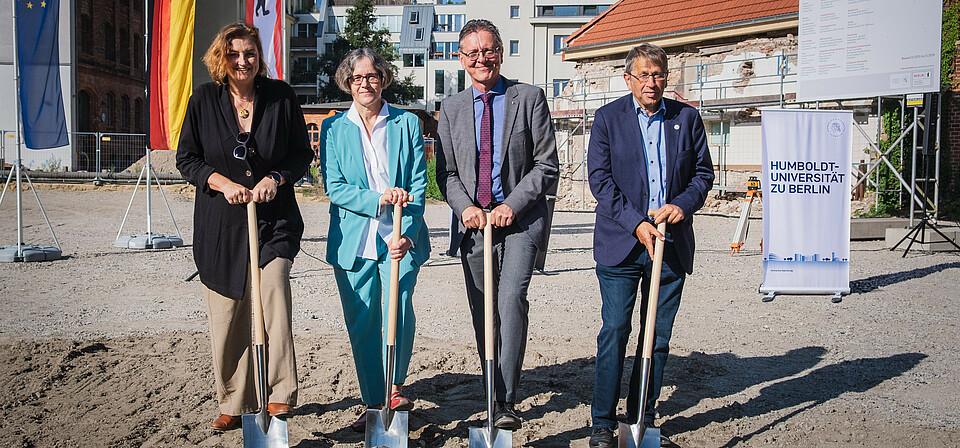
At the groundbreaking ceremony (from left to right): Dr. Ina Czyborra, Senator for Science, Health, and Care, Prof. Dr. Julia von Blumenthal, President of Humboldt University of Berlin, Christian Gaebler, Senator for Urban Development, Construction, and Housing, and Prof. Dr. Heyo K. Kroemer, Chairman of the Board of Charité - Universitätsmedizin Berlin - © Stefan Klenke
Berlin is strengthening its position as a leading life sciences hub with the groundbreaking of a new €81.2 million optobiology research center at Humboldt University. The ambitious project, announced in a press release from Humboldt University, marks a significant investment in cutting-edge biomedical research.
The new facility will span 3,800 square meters and provide state-of-the-art laboratory and office spaces for 110 scientists. Located in Berlin-Mitte, the center represents a collaboration between Humboldt University and Charité – Universitätsmedizin Berlin, creating what officials describe as the centerpiece of an emerging "Life Science" campus.
Professor Julia von Blumenthal, President of Humboldt University, emphasized the project's importance despite current budget constraints. The center will focus on optobiology – the study of how light affects biological systems – with potential applications in diagnosing and treating diseases.
The research program aims to understand and harness light-based biological mechanisms for various medical applications. Scientists will explore how light influences cells, tissues, and organisms, potentially transforming treatments in neuroscience, cardiology, infectious diseases, and regenerative medicine.
The facility will consolidate expertise in photobiology, microscopy, and neurobiological optogenetics under one roof. This integration promises to create bridges between fundamental research and practical applications, advancing Berlin's profile in biomedical innovation.
Funding comes from both federal and state sources, with the German government and Berlin each contributing €33.8 million. The project demonstrates Berlin's commitment to maintaining its competitive edge in the life sciences sector, even amid fiscal challenges.