
Charité & Bayer Launch €76M Biotech Center Project
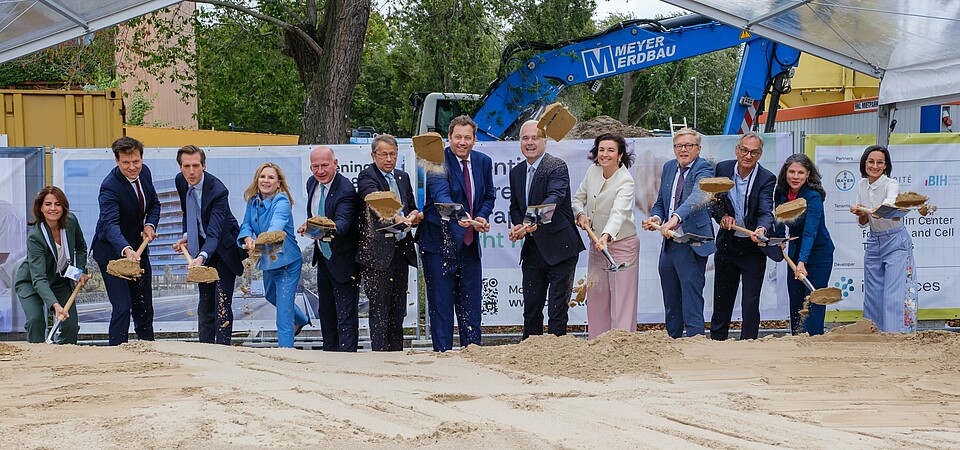
Groundbreaking ceremony for BC GCT (from left): Dr. Marion Hitchcock, Managing Director of Gene & Cell Therapies Incubator Berlin and R&D Strategy & Portfolio Manager at Bayer; Dr. Henry Marx, State Secretary for Science and Research of the State of Berlin; Vincent Wege, Managing Director of iQ spaces; Astrid Lurati, Chief Financial Officer and Head of Infrastructure at Charité; Kai Wegner, Governing Mayor of Berlin; Prof. Heyo K. Kroemer, Chairman of the Executive Board of Charité; Lars Klingbeil, Federal Minister of Finance; Stefan Oelrich, Member of the Board of Management of Bayer AG and Head of the Pharmaceuticals Division; Dorothee Bär, Federal Minister of Research, Technology and Space; Prof. Christopher Baum, Chairman of the Executive Board of the Berlin Institute of Health at Charité (BIH) and Executive Board Member for Translational Research at Charité; Dr. Alfred Merz, Chief Executive Officer of ProBioGen; Dr. Doris Meder, Administrative Director of BIH; Dr. Ruth Shah, Strategic Program Lead Gene Editing, Bayer, and Speaker Head of Co.Lab Berlin - © Bayer & Charité | Norbert Ittermann
Berlin is strengthening its position as a leading European hub for cutting-edge medical treatments with the groundbreaking of the Berlin Center for Gene and Cell Therapies. The ambitious project marks a significant milestone for the German capital's biotech ambitions.
The ceremony at Berlin-Mitte attracted top government officials, including Federal Finance Minister Lars Klingbeil and Federal Research Minister Dorothee Bär, alongside Berlin's Mayor Kai Wegner. This high-level support underscores the project's strategic importance for Germany's healthcare innovation landscape.
The new 10-story, 20,000-square-meter facility at Berlin's Nordhafen will house the core operations by 2028. Charité, Bayer AG, and the Berlin Institute of Health (BIH) are driving this public-private partnership, with federal funding of €76.5 million over ten years supporting the initiative.
The center combines two critical components: a startup incubator accommodating 15-20 companies at various development stages, and a GMP-certified production facility for manufacturing gene and cell therapeutics through clinical Phase II trials. This unique setup addresses the notorious "translation gap" – the challenge of moving breakthrough research from laboratory to patient treatment.
Berlin Mayor Kai Wegner emphasized the vision of creating a "Boston on the Spree," positioning the city as a global biotech powerhouse. The project builds on existing infrastructure, including Bayer Co.Lab Berlin, which has been supporting biopharma startups since 2024 and will relocate to the new facility.
Gene and cell therapies represent hope for patients with conditions where conventional treatments have failed. These "living medicines" can be individually tailored and show particular promise for treating cancer, autoimmune diseases, and rare genetic disorders. Despite hundreds of ongoing clinical trials, few products have reached European approval – precisely the gap this Berlin initiative aims to bridge.
The center will be operated by the newly established Gene and Cell Therapies Incubator Berlin GmbH, with ProBioGen managing the GMP facility operations. HENN architecture firm leads the building design.