
Fraunhofer Unveils AI-Powered Heart Monitoring Vest
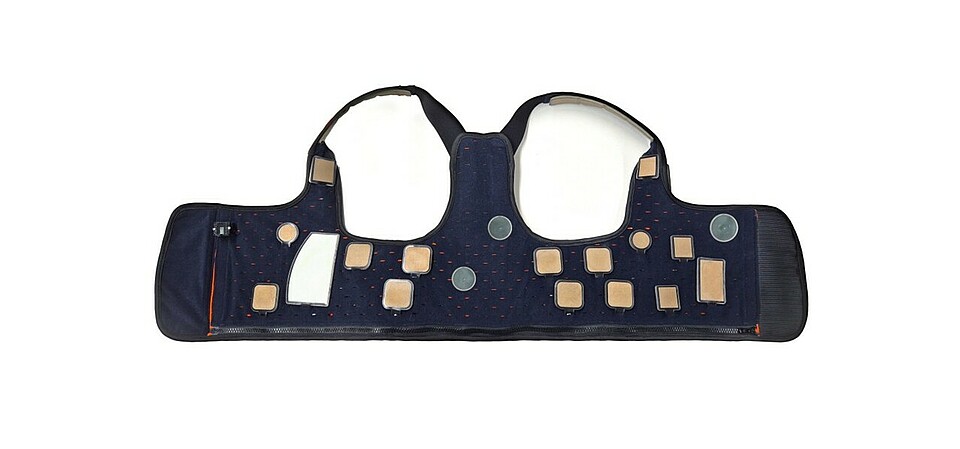
The vest uses multiple non-invasive monitoring methods, including bioimpedance spectroscopy, electrocardiography, seismocardiography, phonocardiography, and photoplethysmography. © Fraunhofer IZM
Catching heart problems early can save lives, but many patients face long waits or travel distances to see specialists. Now, Berlin researchers have created a solution that brings advanced cardiac monitoring directly to patients.
According to a press release, the Fraunhofer Institute for Reliability and Microintegration IZM has partnered with Charité University Hospital and the Technical University of Berlin to develop an AI-powered sensor vest. The innovation is part of the Medical Artificial Intelligence Applications project, which focuses on applied AI in medicine.
The system works surprisingly simply. Patients slip on a washable vest embedded with sensors that track more than 110 cardiovascular parameters, taking a thousand measurements per second. This makes it the world's first system to capture such a comprehensive range of diagnostic data simultaneously and continuously. A built-in chatbot also asks patients about symptoms they're experiencing.
The vest uses multiple non-invasive monitoring methods, including bioimpedance spectroscopy, electrocardiography, seismocardiography, phonocardiography, and photoplethysmography. These readings calculate crucial medical indicators like blood pressure and edema size.
What sets this technology apart is its AI-driven analysis. Machine learning algorithms process the sensor data locally through a mobile edge computing module, combining conventional signal processing with cutting-edge artificial intelligence. The system then provides doctors with diagnostic support and gives patients real-time risk assessments.
The vest's multichannel smart textile electrodes are biocompatible and semidry, eliminating uncomfortable conductive gels. Its modular design adapts to different body types while keeping sensors positioned correctly for stable readings.
Looking ahead, Fraunhofer researchers envision transforming the entire system into reusable stick-on patches made from thin, dermatologically friendly polyurethane. This would make continuous heart monitoring even more comfortable and less restrictive for patients.
The technology promises better access to cardiac care, especially for people in rural areas or those with mobility challenges. Fraunhofer IZM will present the system at Compamed 2025 in Düsseldorf from November 17 to 20.