
New Micro-Laser Could Power Tomorrow's AI Chips
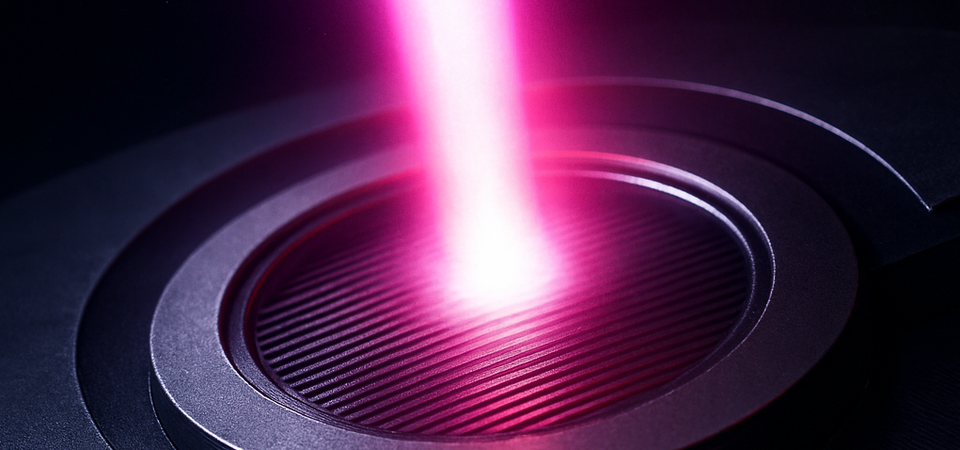
Schematic representation of a microlaser with a nanometer-precise structured surface grating. The compact semiconductor laser generates a directed light beam with a beam profile that is precisely tailored to the respective application. © AG Reitzenstein/TU Berlin
Scientists at Technische Universität Berlin have developed a new type of micro-laser that could make data centers faster, self-driving cars safer, and brain-inspired computers a step closer to reality. According to a press release from TU Berlin, the team behind "Optoelectronics and Quantum Devices," led by Prof. Stephan Reitzenstein, has redesigned a key component inside so-called VCSEL lasers, the workhorses of modern fiber-optic data transmission.
The trick: replacing most of the complex mirror layers on top of the device with a finely etched optical grating. This cuts production time nearly in half and, crucially, allows multiple laser diodes with different output wavelengths to be manufactured in a single step. That kind of flexibility was simply not possible before.
Why does it matter commercially? For data centers, it means cheaper, faster signal coupling into fiber-optic cables. For autonomous vehicles, multi-wavelength laser arrays dramatically improve the resolution of LiDAR distance-sensing systems. And for neuromorphic computing — AI hardware modeled on the human brain, being developed together with partners at Berkeley and MIT — the ability to fine-tune individual laser wavelengths after production solves a stubborn manufacturing problem.
The work was conducted in collaboration with researchers at the University of Łódź in Poland and published in the journal Optica.
Photonics is one of Berlin's defined innovation priorities, and this breakthrough fits neatly into that agenda. The next milestone will be new facilities for the Center for Integrated Photonics Research (CIPHOR) on TU Berlin's East Campus, set to open in 2028.